

Global Automotive Catalytic Converter Market to Reach US$ 198.06 Bn by 2032 at 7.2% CAGR | Persistence Market Research
Automotive Catalytic Converter Market
Global automotive catalytic converter market to reach US$198B by 2032, driven by emission regulations, hybrid adoption, and advanced technologies.
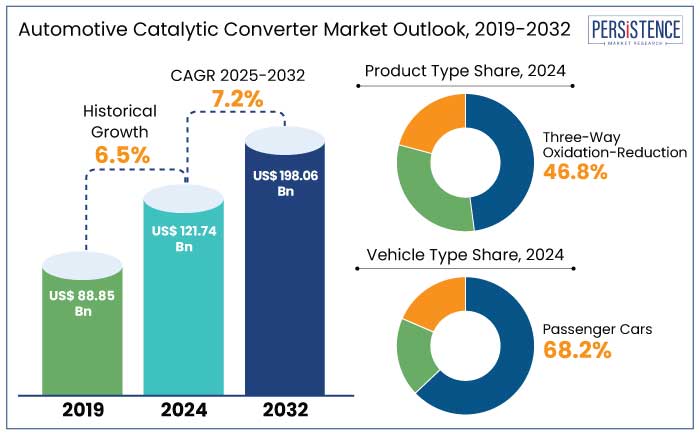
BRENTFORD, LONDON, UNITED KINGDOM, February 4, 2026 /EINPresswire.com/ -- The global automotive catalytic converter market is experiencing robust growth, driven by the increasing focus on emission control and stringent regulatory frameworks across the globe. According to leading market intelligence, the market is estimated to reach a valuation of US$ 121.74 billion in 2025 and is projected to expand at a CAGR of 7.2% during the forecast period, reaching US$ 198.06 billion by 2032. The steady expansion is attributed to the growing adoption of catalytic converters in internal combustion engine (ICE) vehicles, coupled with rising government mandates on reducing vehicular emissions and air pollution.
The growth trajectory is further supported by increasing consumer awareness of environmental sustainability and advancements in catalytic converter technologies that enhance fuel efficiency and lower harmful emissions. Additionally, the automotive industry’s shift toward hybrid vehicles and stricter emission norms such as Euro 6, BS-VI, and Tier 3 regulations are creating high demand for catalytic converters worldwide. Rising urbanization, expanding transportation infrastructure, and recovery in automotive production post-pandemic have also contributed significantly to market growth.
Get Your FREE Sample Report Instantly Click Now: https://www.persistencemarketresearch.com/samples/35049
Automotive Catalytic Converter Market Segmentation
By Product Type
• Two-way Oxidation Catalytic Converter
• Three-way Oxidation Reduction Catalytic Converter
• Diesel Oxidation Catalytic Converter
By Material
• Platinum
• Palladium
• Rhodium
By Vehicle Type
• Two / Three Wheeler
• Passenger Vehicle
• Light Duty Vehicle
• Heavy Duty Vehicles
By Region
• North America
• Europe
• East Asia
• South Asia and Oceania
• Latin America
• The Middle East and Africa
Regional Insights
Geographically, Asia-Pacific dominates the automotive catalytic converter market, led by high vehicle production in China, Japan, and India. The region benefits from rapid industrialization, rising disposable income, and increasing consumer preference for eco-friendly vehicles. North America and Europe also represent significant markets due to stringent environmental regulations and strong aftermarket demand for emission control components.
The fastest-growing region is anticipated to be the Middle East & Africa, fueled by ongoing urbanization, increasing government initiatives for vehicle emission reduction, and rising automotive production in countries like Saudi Arabia and South Africa. Market growth in these regions is accelerated by the adoption of Euro-equivalent emission standards and investments in transportation infrastructure.
Customize This Report for Your Exact Requirements: https://www.persistencemarketresearch.com/request-customization/35049
Unique Features and Innovations in the Market
Modern automotive catalytic converters are no longer just emission control devices. They are increasingly integrated with smart technologies that enhance performance and longevity. Innovations include coating improvements, lightweight substrates, and nano-catalyst formulations that increase catalytic efficiency while reducing precious metal usage.
Emerging technologies such as AI and IoT play a pivotal role in the sector. IoT-enabled sensors monitor real-time exhaust emissions, providing feedback to engine control units (ECUs) for optimized combustion and catalyst performance. Additionally, predictive analytics powered by AI helps in anticipating component degradation, reducing maintenance costs and vehicle downtime. With the anticipated expansion of 5G connectivity, real-time vehicle-to-cloud communication is expected to further enhance the monitoring and efficiency of catalytic converter systems across fleet operations.
Market Highlights
Several factors drive businesses and industries to adopt advanced catalytic converter solutions. Firstly, regulatory compliance is a significant motivator; global governments are imposing strict emissions standards to combat air pollution. Secondly, companies recognize cost reduction potential, as modern catalytic converters contribute to improved fuel efficiency, reducing overall operational expenses. Finally, the sustainability factor encourages OEMs and fleet operators to adopt low-emission technologies to meet corporate environmental goals and consumer expectations.
Automotive catalytic converters are becoming indispensable for achieving the dual objectives of compliance and sustainability, particularly as automakers strive to meet net-zero emission targets and expand hybrid and electric vehicle portfolios.
Key Players and Competitive Landscape
The global automotive catalytic converter market is highly competitive, with key players investing in technological innovations, strategic acquisitions, and regional expansions to strengthen market presence. Prominent companies include:
✦ Bosal NV – Focused on exhaust systems and catalytic converters, emphasizing lightweight designs and advanced emission reduction technologies.
✦ Tenneco Inc. – Leverages strong R&D capabilities to offer integrated emission solutions, including SCR and DOC systems, with regional expansion across North America and Europe.
✦ Faurecia SA – Invests in clean mobility solutions, developing next-generation catalysts for hybrid and electric vehicles.
✦ Eberspächer Group – Specializes in exhaust technology and innovative thermal management solutions to improve catalytic converter efficiency.
✦ Magna International Inc. – Expands global footprint with technology-driven solutions in emission control and aftermarket catalytic converter replacements.
✦ Continental AG – Incorporates AI and IoT solutions into emission systems, enhancing performance monitoring and predictive maintenance.
These companies are pursuing strategies including mergers and acquisitions, strategic partnerships, and continuous product innovation to maintain competitive advantages and meet growing global demand.
Ready to Dive Deep? Buy Full Report Today: https://www.persistencemarketresearch.com/checkout/35049
Recent Developments
✦ Bosal NV expanded its European production capacity in 2025 to address rising demand for advanced catalytic converters in hybrid and EV-compatible vehicles.
✦ Tenneco Inc. launched a next-generation SCR system in 2026, designed to reduce NOx emissions by over 40% in commercial vehicle applications, meeting stricter environmental regulations.
Future Opportunities and Growth Prospects
The automotive catalytic converter market is expected to witness significant opportunities driven by evolving technology, stringent regulations, and growing consumer demand for eco-friendly vehicles. With the gradual shift toward electric and hybrid propulsion systems, manufacturers are developing multi-functional catalytic converters compatible with hybrid engines. There is also potential for expansion in emerging markets, particularly in Southeast Asia, the Middle East, and Africa, where vehicle production and environmental awareness are on the rise.
Technological advancements, such as nano-catalyst materials, coating innovations, and AI-integrated emission monitoring, are anticipated to further enhance product efficiency and lifecycle. Additionally, governments globally are incentivizing green mobility adoption, creating opportunities for OEMs and aftermarket suppliers to expand their product portfolios and establish long-term partnerships with automotive manufacturers.
Persistence Market Research
Persistence Market Research Pvt Ltd
+1 646-878-6329
email us here
Visit us on social media:
LinkedIn
Instagram
Facebook
YouTube
X
Legal Disclaimer:
EIN Presswire provides this news content "as is" without warranty of any kind. We do not accept any responsibility or liability for the accuracy, content, images, videos, licenses, completeness, legality, or reliability of the information contained in this article. If you have any complaints or copyright issues related to this article, kindly contact the author above.
