

Global GHS Label Market to Hit USD 4.4 Billion by 2036 | Compliance Drives Growth | Avery Dennison, 3M, Brady Lead
GHS Label Market
U.S. GHS label market grows 6.2% CAGR, driven by OSHA regulations, robust chemical industry, and rising demand for advanced compliant labeling in supply chains
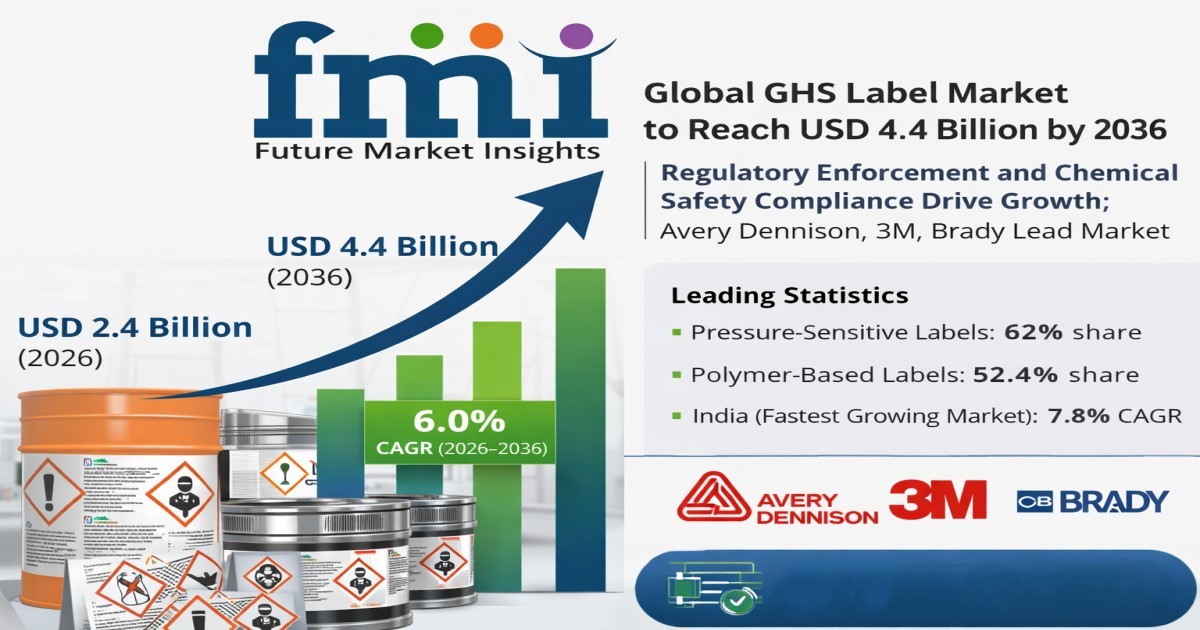
NEWARK , DE, UNITED STATES, March 30, 2026 /EINPresswire.com/ -- The global GHS label market is projected to grow from USD 2.4 billion in 2026 to USD 4.4 billion by 2036, registering a CAGR of 6.0% over the forecast period. This growth reflects the increasing enforcement of the Globally Harmonized System (GHS) for classification and labeling of chemicals across industrial, commercial, and consumer sectors. GHS labels have evolved into critical compliance tools, ensuring hazard communication, workplace safety, and regulatory adherence across global supply chains.
Quick Stats:
• Market Size (2026): USD 2.4 Billion
• Forecast Value (2036): USD 4.4 Billion
• CAGR (2026–2036): 6.0%
• Leading Segment: Pressure-Sensitive Labels – 62% market share
• Leading Material: Polymer-Based Labels – 52.4% share
• Fastest Growing Market: India – 7.8% CAGR
Get Access of Research Report Sample:
https://www.futuremarketinsights.com/reports/sample/rep-gb-9942
Market Perspective: GHS Labels Become Critical to Global Chemical Safety Infrastructure
GHS labeling is transitioning from a regulatory requirement to a core operational necessity in chemical manufacturing and logistics. As global chemical production and trade expand, standardized labeling systems are essential to ensure safe handling, transport, and storage of hazardous materials.
Manufacturers are increasingly adopting durable, high-performance labels that withstand extreme environmental conditions while maintaining readability throughout the product lifecycle. This shift highlights the growing importance of labels as long-term carriers of compliance and safety information.
Key Growth Drivers:
1. Global Harmonization of Chemical Regulations
Governments worldwide are enforcing standardized GHS frameworks, compelling manufacturers to adopt compliant labeling systems for domestic use and international trade.
2. Expansion of Chemical and Pharmaceutical Industries
Rapid growth in chemicals, pharmaceuticals, agrochemicals, and specialty materials is driving demand for accurate and durable hazard communication labels.
3. Increasing Focus on Workplace Safety
Industrial safety initiatives and stricter occupational health regulations are boosting the adoption of GHS labels across manufacturing and logistics operations.
4. Growth in International Chemical Trade
Cross-border movement of hazardous materials requires consistent labeling standards, increasing reliance on globally compliant GHS labeling solutions.
Strategic Industry Trends:
• Material Innovation: Increased adoption of polymer-based labels for enhanced durability and chemical resistance
• Digital Printing Growth: Expansion of digital and variable data printing for customized, multilingual labels
• Smart Label Integration: Use of QR codes, RFID, and NFC for digital compliance and traceability
• Automation Adoption: Integration of high-speed automated labeling systems in chemical plants
Segment Insights:
By Label Type
Pressure-sensitive labels dominate with a 62% share due to superior adhesion, ease of application, and compatibility with automated packaging systems.
By Material
Polymer-based labels lead with 52.4% share, offering resistance to chemicals, moisture, UV exposure, and extreme temperatures.
By Printing Technology
Digital and flexographic printing technologies are widely adopted for their ability to support both large-scale production and customized compliance labeling.
By End Use
Chemical manufacturing remains the largest segment, followed by pharmaceuticals, agrochemicals, and industrial chemicals, all requiring strict hazard communication standards.
Operational Insights:
Industry Challenges
• Frequent updates in global GHS regulations
• Complexity of multilingual and region-specific compliance requirements
• High costs of durable materials and chemical-resistant adhesives
• Price pressure in commoditized label segments
• Need for long-lasting performance in harsh industrial environments
Strategic Responses
• Investment in advanced polymer substrates and specialty adhesives
• Adoption of digital printing and automated labeling systems
• Development of multilingual and customizable label solutions
• Integration with compliance management and tracking systems
• Expansion of smart labeling technologies for traceability
Regional Outlook:
Asia Pacific
Leads global growth, with India (7.8%) and China (7.4%) driven by expanding chemical manufacturing and stronger regulatory enforcement.
North America
The United States (6.2%) maintains strong demand due to strict OSHA regulations and advanced industrial safety practices.
Europe
Germany (5.8%) and other EU countries emphasize high-performance labeling systems aligned with CLP regulations and chemical safety standards.
Latin America
Brazil (6.7%) is emerging as a key market due to growth in agrochemicals and industrial manufacturing.
Competitive Landscape: Compliance Expertise Meets Material Innovation
The GHS label market is highly competitive, with global players focusing on material innovation, regulatory expertise, and advanced printing technologies. Competitive advantage is defined by the ability to deliver durable, compliant, and scalable labeling solutions across industries.
Key Companies:
• Avery Dennison Corporation
• 3M Company
• Brady Corporation
• UPM Raflatac
• Lintec Corporation
• CCL Industries Inc.
• Constantia Flexibles
• Multi-Color Corporation
• Schreiner Group
• Label Power Inc.
Strategic Activities
• Product Innovation: Development of chemical-resistant and weatherproof label materials
• Digital Transformation: Expansion of smart labeling and variable data printing capabilities
• Capacity Expansion: Scaling manufacturing to meet global compliance demand
• Partnerships: Collaboration with chemical manufacturers for integrated compliance solutions
Future Outlook
The GHS label market is expected to evolve into a technology-driven compliance ecosystem. Innovations in smart labeling, advanced materials, and digital compliance platforms will redefine hazard communication standards.
As regulatory complexity increases and chemical production expands globally, GHS labels will play a critical role in ensuring safety, traceability, and operational efficiency across industries.
Frequently Asked Questions (FAQs)
1. What is the market size of the GHS label market in 2026?
The market is estimated at USD 2.4 billion in 2026.
2. What will be the market value by 2036?
The market is projected to reach USD 4.4 billion by 2036.
3. What are the key growth drivers?
Growth is driven by regulatory enforcement, chemical industry expansion, workplace safety initiatives, and global trade requirements.
4. Which segment leads the market?
Pressure-sensitive labels lead with a 62% market share.
5. Which region is growing the fastest?
India is the fastest-growing market with a CAGR of 7.8%.
Why FMI: https://www.futuremarketinsights.com/why-fmi
Explore More Research Reports by FMI:
Boxboard Packaging Market : https://www.futuremarketinsights.com/reports/boxboard-packaging-market
Liquid Packaging Board Market : https://www.futuremarketinsights.com/reports/liquid-packaging-board-market
Industrial Printer Market : https://www.futuremarketinsights.com/reports/industrial-printer-market
About Future Market Insights (FMI)
Future Market Insights (FMI) is a globally recognized market research and consulting firm, delivering data-driven insights across industries. With a strong focus on actionable intelligence, FMI supports organizations in navigating complex market transitions and identifying growth opportunities.
Sudip Saha
Future Market Insights Inc.
+1 347-918-3531
rahul.singh@futuremarketinsights.com
Legal Disclaimer:
EIN Presswire provides this news content "as is" without warranty of any kind. We do not accept any responsibility or liability for the accuracy, content, images, videos, licenses, completeness, legality, or reliability of the information contained in this article. If you have any complaints or copyright issues related to this article, kindly contact the author above.
