

Printed and Chipless Radio Frequency Identification (RFID) Market Tops $21 Billion by 2030, Avery Dennison 7%

Printed And Chipless Radio Frequency Identification (RFID) Market Overview

Printed And Chipless Radio Frequency Identification (RFID) Market
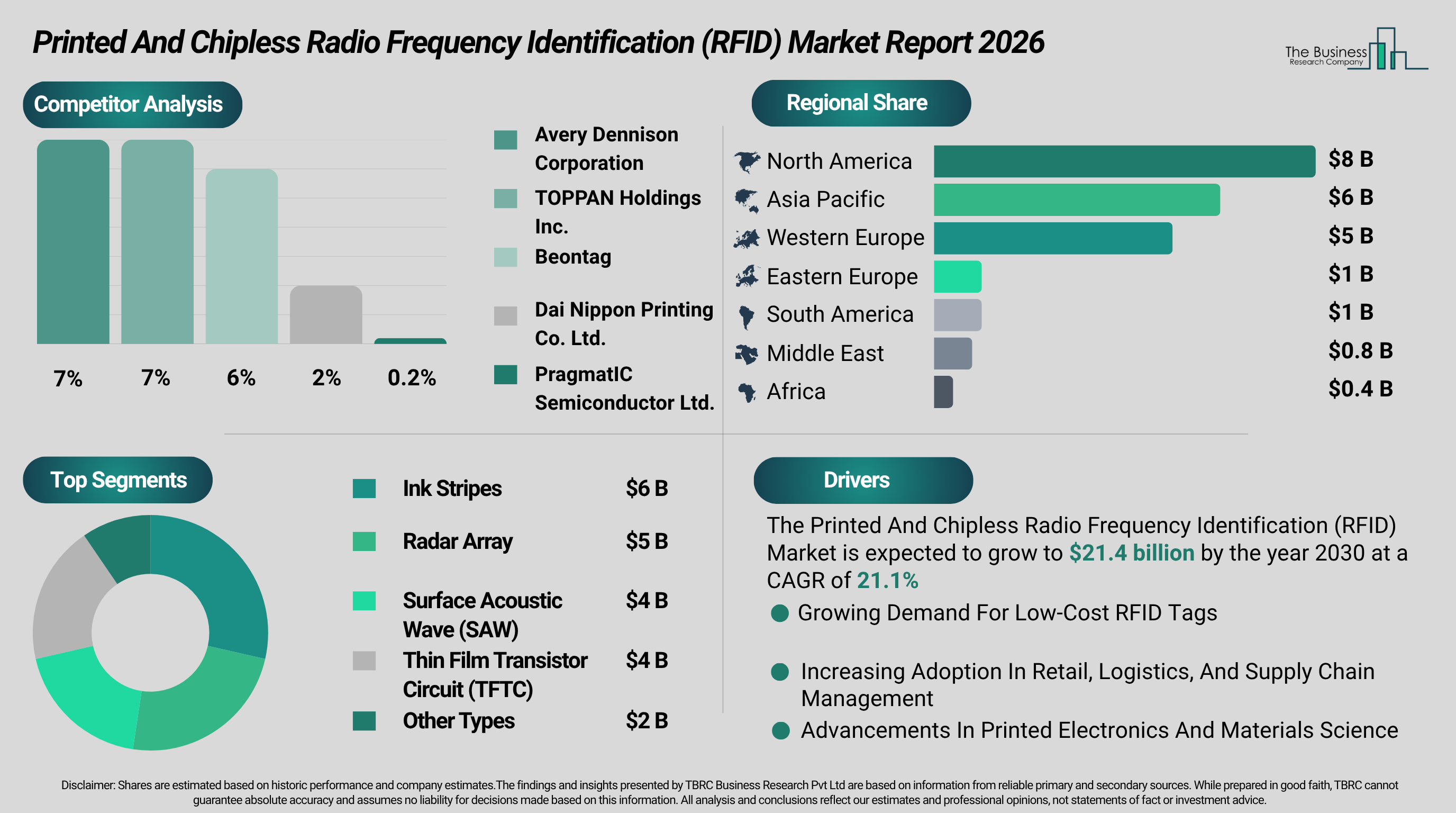
Printed And Chipless Radio Frequency Identification (RFID) Market Size
The Business Research Company's Printed and Chipless Radio Frequency Identification (RFID) Market Tops $21 Billion by 2030, Avery Dennison 7%
LONDON, GREATER LONDON, UNITED KINGDOM, October 12, 2026 /EINPresswire.com/ -- "Understanding the growing importance of identification and tracking technologies is crucial in today’s interconnected world. The printed and chipless radio frequency identification (RFID) market is rapidly evolving, driven by advancements in printed electronics and increasing demand across various sectors such as retail, healthcare, and logistics. This overview delves into the major players, market dynamics, innovations, and future outlook shaping this expanding field.
Market Leaders and Their Influence in the Printed and Chipless RFID Market
Global leaders in RFID technology, semiconductor manufacturing, and specialized identification solutions hold a dominant position in the printed and chipless RFID market. These companies emphasize innovation in printed electronics, chipless identification methods, flexible tag designs, and cost-efficient scalable production. Their efforts focus on enhancing supply chain management, retail inventory control, healthcare tracking, logistics automation, and industrial applications. Key competitive advantages revolve around affordability, improved tracking precision, eco-friendly tags, and seamless integration with Internet of Things (IoT) and digital inventory systems. Stakeholders aiming for growth and innovation must navigate this complex and dynamic landscape carefully.
Request A Free Sample Of The Printed And Chipless Radio Frequency Identification (RFID) Market Report
https://thebusinessresearchcompany.com/sample_request?id=36873429&type=smp&name=Printed%20And%20Chipless%20Radio%20Frequency%20Identification%20%28RFID%29%20Market%20Report%202026&utm_source=EINPresswire&utm_medium=Paid&utm_campaign=Oct_PR
Who Tops the Printed and Chipless RFID Market in 2025?
According to The Business Research Company, Avery Dennison Corporation led global sales in 2025, capturing a 7% market share. Their RFID and digital identification segment supplies a range of products including RFID inlays, printed electronics, smart labels, and technologies that enhance supply chain transparency, retail operations, inventory management, and asset tracking, making them a key player in the printed and chipless RFID market.
Market Structure and Share Breakdown Among Top Players
The printed and chipless RFID market is moderately fragmented, with the leading 10 companies accounting for 22% of total revenues in 2025. Entry into the market requires overcoming technological and manufacturing challenges, such as developing advanced printed electronics, ensuring cost-effective production, providing reliable identification, and integrating with digital tracking platforms. These top firms maintain their positions through diversified RFID offerings, state-of-the-art printed electronics, strategic alliances, global distribution channels, and ongoing innovation in chipless identification and smart labeling. Growth in demand for affordable identification, flexible tag formats, sustainable solutions, and IoT-enabled supply chains fuels their competitive edge and encourages regional expansion.
Access The Detailed Printed And Chipless Radio Frequency Identification (RFID) Market Report Here
https://thebusinessresearchcompany.com/report/printed-and-chipless-radio-frequency-identification-rfid-global-market-report?utm_source=EINPresswire&utm_medium=Paid&utm_campaign=Oct_PR
Market Share Distribution Among Leading Companies in 2025
• Avery Dennison Corporation holds 7%
• TOPPAN Holdings Inc. holds 7%
• Beontag controls 6%
• Dai Nippon Printing Co. Ltd. accounts for 2%
• PragmatIC Semiconductor Ltd. owns 0.2%
• Tageos SAS holds 0.2%
• VTT Technical Research Centre of Finland Ltd. holds 0.2%
• SATO Holdings Corporation has 0.2%
• Murata Manufacturing Co., Ltd. holds 0.2%
• Fedrigoni S.p.A. possesses 0.2%
Sustainable Innovations Transforming the Printed and Chipless RFID Market
One of the most significant advances reshaping this market is laser-induced carbon-based conductive circuit technology. This innovation enhances sustainability by making RFID tags more eco-friendly, reducing manufacturing costs, and enabling scalable production methods. For example, in June 2024, Pulpatronics Limited introduced chipless, metal-free RFID tags crafted from paper, using laser-induced conductive circuits. This approach minimizes environmental footprints, lowers expenses, and supports sustainable asset tracking.
How Industry Leaders Are Staying Competitive in the Printed and Chipless RFID Market
Leading companies focus on boosting scalability and adaptability of printed and chipless RFID technologies. They continually refine design and manufacturing processes to improve device performance and energy efficiency. Additionally, they are expanding RFID integration to enhance asset tracking and supply chain transparency. By combining data processing and sensing capabilities, these market players are advancing monitoring and automation solutions that meet evolving industrial demands.
Projected Market Value and Growth Rate of the Printed and Chipless RFID Industry
The printed and chipless RFID market is anticipated to surpass $21 billion by 2030. Its broader sector, Power Generation, Transmission and Control Equipment, is projected to reach roughly $685 billion by the same year, with printed and chipless RFID comprising about 3% of this total. Within the expansive Electrical and Electronics industry, expected to hit $5,579 billion by 2030, this market represents nearly 0.4%. The forecasted compound annual growth rate (CAGR) for printed and chipless RFID is 21% through 2030, reflecting strong demand and technological progress.
Regional Growth and Market Outlook for Printed and Chipless RFID
North America is set to remain the largest regional market for printed and chipless RFID by 2030, with an estimated valuation of $8 billion, up from $3 billion in 2025, driven by a CAGR of 21%. This robust growth stems from increased adoption of smart labels in retail and logistics, demand for printable identification in supply chain traceability, chipless RFID use in inventory and anti-counterfeiting, and investments in printed electronics research and commercialization across the United States and Canada.
Country-Specific Market Leadership in Printed and Chipless RFID
The United States is projected to be the top single-country market in printed and chipless RFID in 2030, valued at $7 billion, growing from $2 billion in 2025 at a 22% CAGR. Factors contributing to this rapid expansion include smart packaging, connected labeling innovations, investments in next-generation printed electronics, demand for affordable asset tracking solutions in retail, healthcare, and defense sectors, chipless RFID for authentication and security, and advancements in flexible conductive materials and printable sensors.
Segment Breakdown and Dominant Types in the Printed and Chipless RFID Market
By technology type, the market encompasses ink stripes, radar arrays, thin film transistor circuits (TFTC), surface acoustic wave (SAW), and other variants. Ink stripes are expected to be the largest segment by 2030, representing 29% of the market or $6 billion. This growth is driven by demand for low-cost printable tags, conductive inks suited for high-volume label production, ink-based RFID in fast-moving consumer goods and logistics, improved ink formulas for accuracy, disposable smart labels for product traceability, and compatibility with flexible packaging and printed electronics manufacturing.
Additional Technology and Application Segments
The printed and chipless RFID market is also categorized by technology into time-domain, frequency-domain, magnetic-based, acoustic-based, and other methods. Application-wise, the market serves retail, transport and logistics, aviation, healthcare, and various other sectors.
Main Drivers Accelerating Growth in Printed and Chipless RFID
Several key factors are fueling the rapid expansion of the global printed and chipless RFID market through 2030. These include the growing demand for affordable RFID tags, widespread adoption in retail and logistics supply chains, and progress in printed electronics and materials science.
Rising Demand for Cost-Effective RFID Tags
By eliminating expensive silicon chips, printed and chipless RFID tags significantly reduce manufacturing costs while maintaining reliable identification. This affordability makes item-level tracking accessible for high-volume industries such as retail, logistics, healthcare, and packaging. It also opens opportunities for small and medium enterprises. This factor is expected to contribute approximately 1.8% annual market growth.
Widespread Adoption in Retail, Logistics, and Supply Chain Management
The technology enables real-time inventory tracking, faster restocking, and precise asset management with fewer manual errors. Retailers and logistics providers increasingly rely on these automated systems to prevent stock loss and streamline order fulfillment. The low cost and scalability of printed and chipless RFID drive this adoption, contributing an estimated 1.5% annual market growth.
Technological Advances in Printed Electronics and Materials
Improvements in conductive inks, flexible substrates, and printing methods lead to lightweight, efficient RFID tags produced at lower cost and consistent quality on a large scale. Enhanced materials broaden usage scenarios, including smart packaging and healthcare tracking. This driver is projected to add around 1.3% annual growth to the market.
Major Growth Prospects Across Printed and Chipless RFID Segments
Each of the five type segments is projected to see substantial growth, collectively adding more than $13 billion in market value by 2030. From 2025 to 2030, ink stripes, radar arrays, thin film transistor circuits (TFTC), and surface acoustic wave (SAW) technologies are all expected to increase by about $3 billion each, while other types will grow by $1 billion. This expansion is fueled by chipless identification for large-scale item tracking, demand for printable flexible electronics, contactless authentication innovations in commerce and industry, advancements in passive wireless sensing, and scalable, sustainable manufacturing approaches. These trends reflect the ongoing evolution of smart packaging and interconnected supply chains.
Overview of the Printed and Chipless RFID Market Supply Chain and Users
Raw material suppliers in this domain include DuPont de Nemours, Henkel, BASF, Dow, Merck, Sun Chemical, Toyo Ink, DIC Corporation, Flint Group, Siegwerk, Fujifilm, Eastman Chemical, Covestro, Evonik, Solvay, Arkema, Mitsubishi Chemical, Toray Industries, Avery Dennison, Nitto Denko, Kuraray, PolyOne, Cabot, Heraeus, and Tokuyama Corporation.
Wholesalers and distributors encompass companies such as Arrow Electronics, Avnet, Digi-Key, Mouser Electronics, TTI, RS Group, Newark Electronics, Allied Electronics & Automation, Rutronik, Farnell Global, element14, WPG Holdings, Macnica, Ingram Micro, TD ScanSource, Bechtle, ALSO Holding, Esprinet, Redington, Exclusive Networks, Mindware, Logicom, and EET Group.
End users span across Zebra Technologies, Impinj, Identiv, Alien Technology, Avery Dennison Smartrac, Checkpoint Systems, SML Group, Tageos, HID Global, Invengo Technology, Nedap, FEIG Electronic, CAEN RFID, Confidex, RF Technologies, Mojix, RFID Global Solution, Bluebird, GAO RFID, Turck Holding, Beontag, Sensormatic Solutions, Decathlon, Walmart, and Amazon.
Who Are the Key Participants Driving the Printed and Chipless RFID Market?
The main companies shaping this market include Avery Dennison Corporation, TOPPAN Holdings Inc., Beontag, Dai Nippon Printing Co. Ltd., PragmatIC Semiconductor Ltd., Tageos SAS, VTT Technical Research Centre of Finland Ltd., SATO Holdings Corporation, Murata Manufacturing, Fedrigoni S.p.A., Alien Technology LLC, Checkpoint Systems Inc., Invengo Information Technology, All4Labels Group, Identiv, Stora Enso Oyj, 3M, Siemens AG, IDTRONIC GmbH, and Toppan Printing.
Our 2026 market reports now offer broader strategic coverage through market attractiveness scoring and analysis, total addressable market (TAM) analysis, company scoring matrix graphics and tables, Excel-based forecasting dashboards, market hotspots infographics, key technologies and future trend analysis, along with updated graphics and tables.
About The Business Research Company
The Business Research Company (www.thebusinessresearchcompany.com) is a renowned market intelligence firm specializing in company, market, and consumer research. With over 30,000+ reports spanning 27 industries and more than 60 geographies, their insights draw upon 1.5 million datasets, extensive secondary research, and interviews with industry leaders. They offer a range of tailored research packages such as Market Entry, Competitor Tracking, and Supplier & Distributor packages.
Disclaimer: The information provided by TBRC Business Research Pvt Ltd is gathered in good faith from primary and secondary sources, though accuracy cannot be fully guaranteed. The company disclaims liability for any actions taken based on its findings, which are intended as estimates and opinions rather than definitive facts or investment advice.
Contact Information
The Business Research Company
Americas: +1 310-496-7795
Europe: +44 7882 955267
Asia & Others: +44 7882 955267 / +91 8897263534
Email: marketing@tbrc.info
Follow on LinkedIn: https://in.linkedin.com/company/the-business-research-company"
Oliver Guirdham
The Business Research Company
7882 955267
info@tbrc.info
Visit us on social media:
LinkedIn
Facebook
X
Legal Disclaimer:
EIN Presswire provides this news content "as is" without warranty of any kind. We do not accept any responsibility or liability for the accuracy, content, images, videos, licenses, completeness, legality, or reliability of the information contained in this article. If you have any complaints or copyright issues related to this article, kindly contact the author above.
