

Busch Group Expert Explains Growing Importance of Test Environment Characterization in Space Simulation
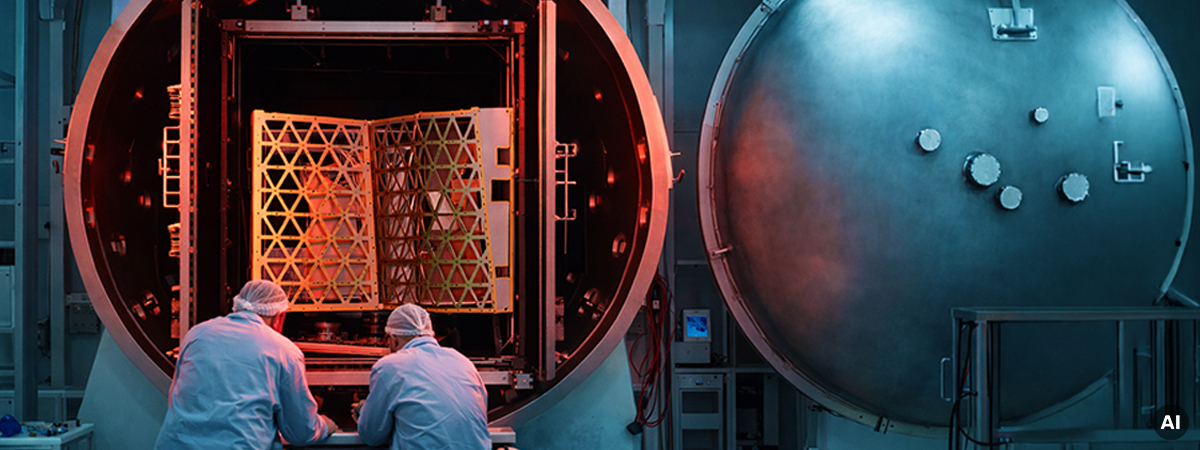
Two scientists in front of a vacuum chamber used for testing. Source: Busch Group.
Why the test facility is becoming the critical system
ASSLAR, GERMANY, October 11, 2026 /EINPresswire.com/ -- Every space mission is based on tests on Earth. Before spacecraft, propulsion systems or instruments are deployed, their performance must be verified under mission-relevant conditions. Creating space-like conditions remains essential. Increasingly, however, the challenge is ensuring that the test environment does not influence the behavior being measured. Technical instruments such as optics and detectors are becoming increasingly sensitive. [1] Cleanliness and stable conditions are therefore crucial for a suitable test environment. One may think: The chamber has reached the target pressure below 10-6 hPa (mbar). Can the test begin? However, the pressure level itself is not the only target. Residual-gas composition, temperature, pressure stability and contamination are equally relevant.
Two facilities may operate at the same pressure level while exposing the test article to very different environments.
What pressure reading does not show:
1. Tests performed at the same pressure level can expose hardware to different residual gases. [2] Many electric-propulsion facilities operate under xenon loads, while baked UHV systems are typically dominated by hydrogen. [3,4] Other species, such as water vapor or hydrocarbons, may also be present. Because surface interactions, such as adsorption or condensation, depend on the gas species involved, residual-gas composition can influence contamination behavior and ultimately the validity of the test results. For contamination-sensitive hardware, such as optical instruments, detectors or infrared systems, gas composition may therefore be just as important as total pressure.
2. Conductance is another limiting factor. It describes how effectively gas can flow through an opening or connecting element. In high and ultra-high vacuum, conductance is mainly determined by geometry, not by pressure difference. Therefore, the pumping speed specified at the pump inlet is rarely identical to the effective pumping speed at the test article, especially if the connecting path restricts molecular gas flow. A direct connection between pump and chamber is usually preferable. However, baffles, cryoshields or piping are often required, and each of these components can reduce the effective pumping speed of a high vacuum pump.
3. Thermal interactions: In a thermal-vacuum test, a local temperature reading alone does not fully describe the thermal environment of the test article. Heat transfer under space-like vacuum conditions is typically dominated by radiation [5], while conduction remains possible through structural interfaces. Therefore, parameters such as shroud temperature [5], view factors [5], shroud emissivity [5], radiative coupling and thermal uniformity become critical. If these boundary conditions differ from the mission scenario, hardware may reach the expected local temperature while still experiencing a nonrepresentative radiative environment, potentially affecting the validity of the test results.
When testing changes the test article
The test facility may influence the hardware itself. Outgassing results in an increased local gas load and contamination. Optical surfaces, infrared detectors and mirrors can be affected by molecular contamination layers that alter optical transmission, reflectivity or detector performance. Deposited contamination layers can also alter the absorptivity and emissivity of thermal-control surfaces, thereby changing their thermal behavior. [6,7]
Electric-propulsion testing provides another example. The test facility can influence thrust measurements, plasma behavior and efficiency. Reasons for this include background pressure, plume-wall interaction and xenon loading. During electric-propulsion operation, the thruster can be treated as a controlled gas load into the chamber. Maintaining representative test conditions therefore requires pumping technology with enough effective pumping speed and gas throughput capacity to prevent the propellant flow from driving the background pressure beyond the defined operating range. [3]
In research and industry, a key question is: Can we reproduce the same environment every time? Why it matters:
• Long-term stability: Test conditions must remain stable over extended test durations, which could be days or even weeks.
• Calibration: Reliable results depend on accurately calibrated instrumentation.
• Facility characterization: The influence of the test facility must be quantified and understood.
• Monitoring: Key environmental parameters require continuous observation.
• Traceability: Measurements must be linked to documented standards and calibration data.
As spacecraft becomes more complex, understanding the test environment becomes just as important as understanding the hardware under test. Reaching a target pressure is only one part of this task. Residual-gas composition, thermal boundary conditions, contamination behavior and pumping performance all determine whether a test is representative. Well-characterized vacuum systems help identify and control these effects on Earth, where corrections are still possible and far less costly than during a mission.
Bibliography
[1] Jacobs, F., Martins, R., Van den Eynde, J. et al., Spacecraft cavity venting and outgassing analysis applied to the SMILE mission. CEAS Space J 17, 877–890, 2025.
[2] CERN CAS tutorial on RGA, Interpretation of RGA Specta; https://indico.cern.ch/event/565314/contributions/2285748/attachments/1467497/2273709/RGA_tutorial-interpretation.pdf; 27.08.2026, 10:15.
[3] Hofer, R., Peterson, P. Y., Gallimore, A. D., Characterizing Vacuum Facility Backpressure Effects on the Performance of a Hall Thruster; https://pepl.engin.umich.edu/pdf/IEPC-01-045_Facility_Effects.pdf; 27.08.2026, 10:45.
[4] Fedchaka, J.A. et al. National Institute of Standards and Technology, Gaithersburg, MD 20899; https://tsapps.nist.gov/publication/get_pdf.cfm?pub_id=924339; 27.08.2026, 10:20.
[5] Case Study: The Role of Thermal Shrouds in Space Simulation and Bakeout Chambers; https://aeon-eng.com/case-studies/the-role-of-thermal-shrouds-in-space-simulation-and-bakeout-chambers/; 24.08.2026, 14:20.
[6] Contamination Engineering Design Guidelines, NASA; https://epact2.gsfc.nasa.gov/tycho/STEREOContamControl.htm#_Toc511378274;, 24.08.2026, 10:25.
[7] Lubos Brieda; Molecular Contamination Modeling with CTSP; https://particleincell.com/files/papers/ctsp-rgd.pdf; 27.08.2026, 11:00.
Dr Sandra Thirtle-Höck
Busch Group
+49 641 8021460
Legal Disclaimer:
EIN Presswire provides this news content "as is" without warranty of any kind. We do not accept any responsibility or liability for the accuracy, content, images, videos, licenses, completeness, legality, or reliability of the information contained in this article. If you have any complaints or copyright issues related to this article, kindly contact the author above.
